● Open for Opportunities

Viknesh Vijayakumar
Senior Product Designer
Viknesh Vijayakumar
Senior Product Designer
Reduced output creation time from days to hours by eliminating manual workflows
0→1 System Redesign
Enterprise Workflow
Role
Sole Product Designer
Timeline
4 months
Product
Enterprise Case Management
Team
Designer (me) + Engineering + Stakeholders
01 — Quick Overview
Replacing manual PDF workflow with a scalable, system driven workflow
Output creation was a critical part of the system, but it relied on slow, manual workflows that didn’t scale.
●
Problem
Manual setup process
Creating outputs required manual mapping, static PDF templates, and developer involvement, making the process slow and error-prone.
●
Solution
Dynamic output builder
Replaced manual mapping with a visual system where users work directly with form data instead of response codes.
●
Impact
Days → hours
Reduced output creation time from days to hours and enabled non-technical users to create and update outputs independently.
02 — how it works now
The legacy workflow
Organizations using myOneFlow rely on structured forms to generate official outputs for government and university submissions, making output generation a critical part of their workflow.
But creating these outputs was a long, manual, engineering-heavy process that involved third party tools. Engineers had to extract response codes from the forms, recreate layouts in third-party PDF tools, map each code to the correct fields, and repeatedly upload and test the output. Even small changes required rebuilding the entire document. What should have taken hours often took days.
As organizations scaled to dozens of forms and multiple outputs for each, this process became time-consuming, error-prone, and expensive for both the platform and the organizations.

03 — The Problem
A manual system that didn’t scale
Manual setup process
Each new output consumed multiple engineering days even for standard, recurring document types.
Dependent on engineers
No output could be created or updated without major rework and engineer involvement.
Mapping errors and inconsistency
Manual answer code placement introduced frequent errors across different output versions.
Full rebuild for small changes
Updating a single field required reconstructing the entire layout and upload again.
Infrastructure overhead
Static PDF storage and processing created significant unnecessary infrastructure cost.
No version control
Each change created a new static file with no traceable history or rollback capability.
Key Insight
The problem wasn't PDF generation, it was the dependency on manual mapping and static output templates that made the entire system complex.
04 — Strategy
Redefining the approach
The initial goal was to bring PDF creation inside the system to reduce reliance on external tools. But as I dug deeper into the workflow, it became clear that the real problem wasn’t where PDFs were created. It was how they were created.
Every output depended on manually mapping response codes to static PDF templates. It was slow, fragile, and difficult to scale. Improving this flow would only make a broken system slightly better. So instead of asking how we could make PDF creation easier, I stepped back and asked a different question
What if we could eliminate manual mapping — and the need for static PDFs — altogether?
This shifted the focus from improving a workflow to rethinking the system itself.
05 — Design Decisions
Designing a simpler way to create form outputs
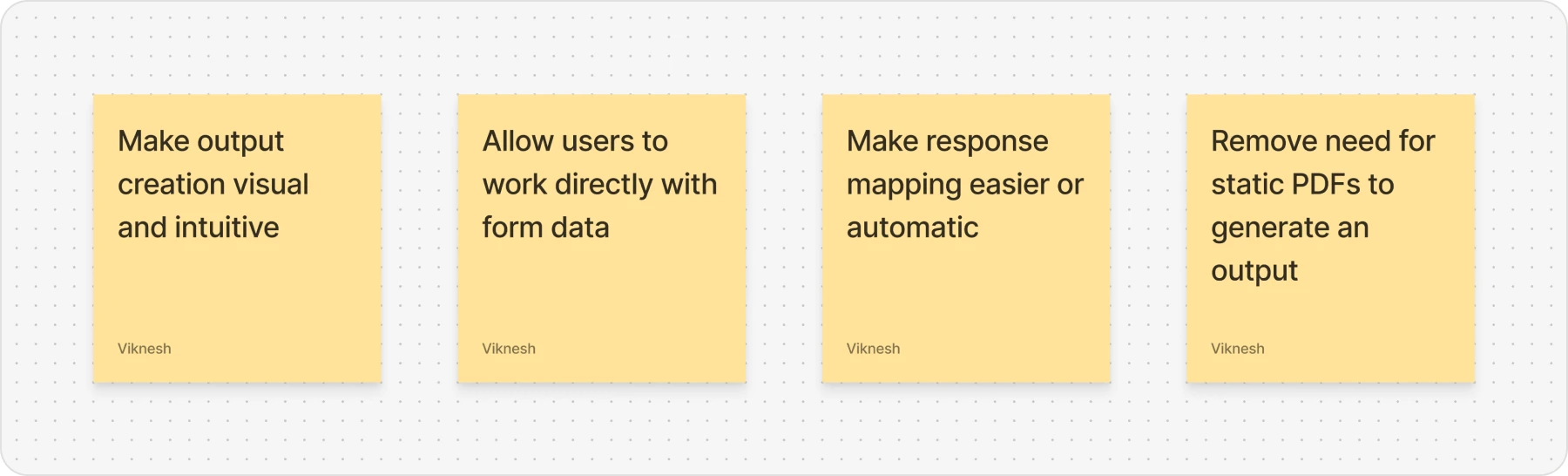
To support this new workflow, I introduced four key changes:
Build outputs visually
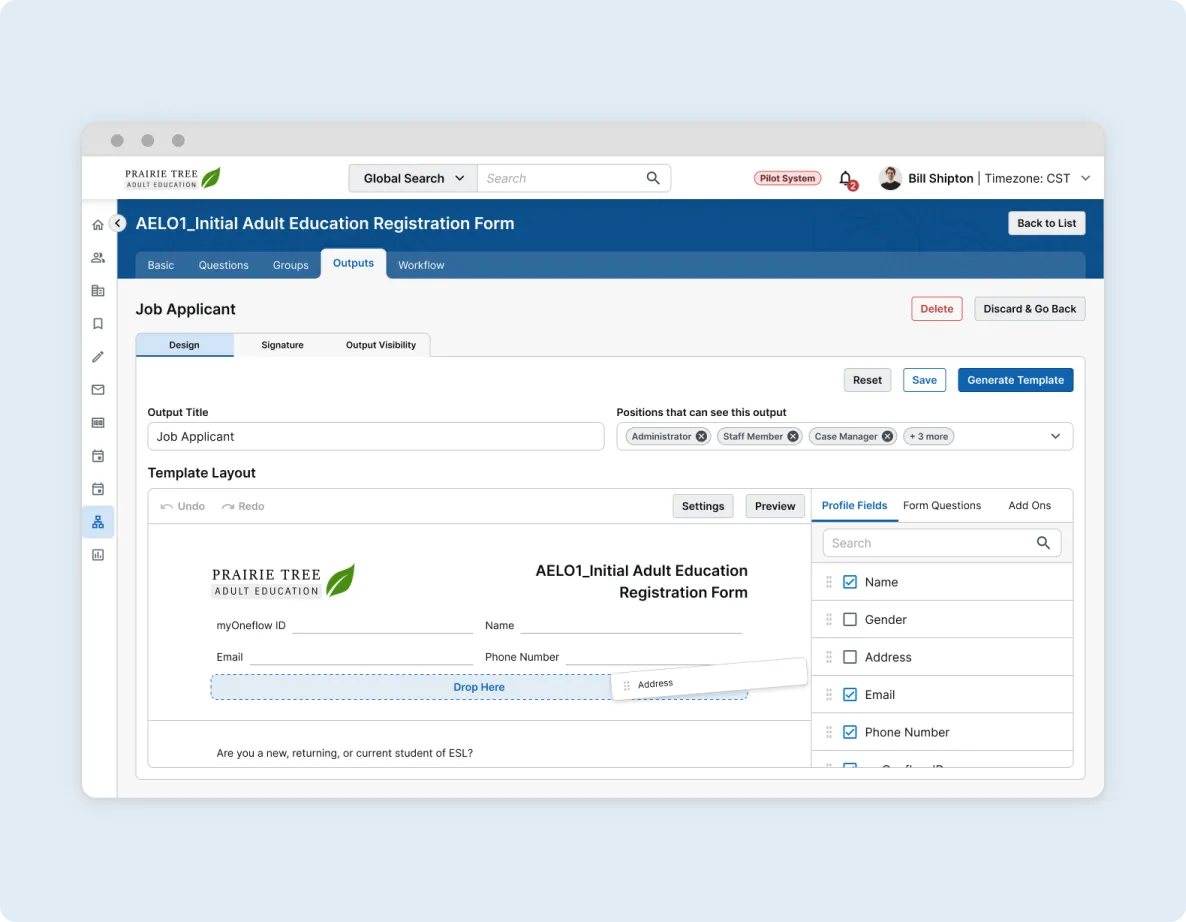
A visual builder where users can drag and drop profile fields, form fields, and custom elements to create output layouts and customize them.
how it helps
Reduced time required to create outputs
Makes output creation easier for non-technical users
Work with data, not codes
Users can directly select form questions and data fields, while the system handles mapping and structure in the background.
how it helps
Eliminates the need for engineers to manually map response codes
Reduces cognitive load and human errors
Smart defaults for faster setup
Org level predefined layouts with commonly used elements automatically included.
how it helps
Reduces repetitive setup
Ensures consistency

Customizations, simple yet flexible
Users can control how outputs are presented without dealing with complex layout systems.
how it helps
Provides flexibility without overwhelming users
Keeps the system simple and easy to use
Provides flexibility without overwhelming users
06 — The Solution
From manual workflows to a visual system
What once required days of coordination between tools and engineers is now a simple, self-serve process.
Users can create outputs directly within the system by selecting fields, arranging layouts, and publishing — all without dealing with response codes or static templates. The system handles the complexity in the background, allowing users to focus only on what matters — the output itself.
Form Setup
Questionnaires are created with unique response codes.
Visual Output Builder
Build outputs directly using form data without any manual mapping or response codes
Iterate & Publish
Make updates and publish changes instantly. PDFs generated only when needed.
07 — Impact
From bottleneck to a scalable system!
The new output builder transformed a slow, engineering-heavy process into a fast, self-serve workflow.
This had a direct impact on onboarding. With each organization requiring dozens of forms and multiple outputs, reducing setup time from days to hours enabled faster implementation and quicker transitions from pilot to production. What was once a bottleneck became a scalable capability.
2 to 3 days → 1 to 3 hours
Reduced output creation time by up to 90%, resulting in significantly faster implementation cycles
Engineer-driven → Self-serve
Clients can create and manage outputs independently without relying on engineers
Manual → Automated
Eliminating manual mapping reduced human errors and system complexity
Rebuild→ Instant Update
Changes no longer require recreating outputs in external tools
08 — On the other hand
Exploring a more radical approach
What if we designed for the output first — and let the system handle the rest?
While solving the current problem, I explored whether the system itself could be simplified further by removing the need for forms and mapping altogether.
Most form data originated from existing profile fields. Outputs relied on the same data collected through forms. The system required creating forms and then mapping them again to outputs — introducing duplication and unnecessary setup effort.
What if?
Admin defines only the outputs
System auto-populates available data
Users fill in only the missing data
Review, sign and confirm before submission
Why this could work?
No separate form setup
No mapping layer
Faster implementation
Reduced system complexity
Lesser information to fill for the users
This required a fundamental change in the system which required rethinking existing edge cases and rewriting core system logic. As this was not within project’s scope, we prioritized an incremental approach.
09 — Reflection
In complex systems, simplifying the model has a greater impact than improving the interface.
This project reshaped how I approach complex systems. The initial direction focused on making PDF creation easier, but the real impact came from stepping back and questioning the workflow itself.
By moving away from optimizing individual steps, the workflow became faster, scalable, and more reliable. We significantly improved onboarding speed with faster implementation for organizations with dozens of forms and multiple outputs. More importantly allowing controlled flexibility in customization brought non-technical org admins a step closer in creating their own outputs. What was once a bottleneck in implementation became a scalable capability.